
Why Elope in Washington: A Complete Guide to the Best Locations and Tips
Elope in washington
Dreamy events & celebrations that inspire.
There are few places that better straddle the line between wild and accessible. It’s perfect for the wild souls looking to take the next steps together.
Washington State is truly wonderful
Elope in the best of the Northwest
The Evergreen State is most known for, well, being evergreen. While that is true, Washington is also one of the most diverse, accessible, easy and downright beautiful places to elope. If you are dreaming of misty forests, high alpine ridges, windy coastlines with miles of sand, rolling wheat fields, quiet rivers, waterfalls, lakes, islands or something completely your own, you can find it here. Add in state laws that celebrate inclusivity and a simple process for getting your marriage license, and a Washington elopement becomes something you can shape to fit who you are.
I know that having endless options can make it hard to choose. That is where I come in.
This guide will help you move from dreaming to holding your partner’s hand in a place that feels right for you. Let’s make your day real.
I’m Joe. I am an elopement and wedding photographer based in Seattle, and I have been photographing weddings since 2011. I was born here and I still get stunned by how much beauty we have tucked into this corner of the world. While I do not offer full service planning, I am deeply experienced in guiding couples through every step of planning an elopement in Washington. Use this guide to get started, and reach out anytime. I want everyone to have the best experience possible here. If you need advice, referrals or a quick phone call to talk things through, I am here to help.
What makes Washington perfect for elopements?
Washington is one of the few places where every landscape feels like its own world. The mountains rise fast and sharp, the forests are soft and quiet, and the coast feels wild in a way that makes you slow down. Each region has its own personality, which means you can shape your elopement to match the kind of day you want.
In the mountains, you get those moments where the sun rises over a ridge and everything turns gold for a few minutes. You might hear nothing except a few birds, the wind, and your partner breathing beside you. Later in the day, the light changes and the peaks shift from bright to blue to deep shadow. It feels like you get five different moods in a single afternoon.
The forests have their own magic. The air is cool even in summer and the ground is soft from years of moss and fallen needles. Light filters through the trees in narrow rays. You can read vows here and feel like the whole world has stepped back to give you privacy. It is calm in a way that feels needed.
The coast is a different kind of beautiful. Waves hit the shore with a steady rhythm and the wind carries salt that you can actually taste. The beaches stretch for miles and the sea stacks look like sculptures rising out of the water. If you want a ceremony where you walk barefoot across wet sand or end the night with a fire in the distance, this is where that happens.
Then there are the quieter places. Lakes with glassy surfaces that reflect the sky. Rolling hills that feel warm and open. Islands with little pockets of solitude. You do not have to go far to find a place that feels like your own.
The variety is incredible, but what ties everything together is the sense of space. Washington gives you room to breathe, room to be yourselves and room to create a day that feels honest. You can keep things simple or make the day as adventurous as you want. Either way, the landscape supports your story rather than distracting from it.
That is what makes Washington perfect for elopements.
What is the best season for eloping in Washington?
Contrary to popular belief, Washington really does have four seasons. Not every corner of the state gets all four in the same way, but if you know where to look, you can find them. Each season brings its own personality, its own challenges, and its own magic. Below is a breakdown of what each time of year actually feels like, along with a few landscapes that shine during that season.

Summer
Summer in Washington is the reward we patiently wait for all winter. In Western Washington, especially, the PNWet reputation disappears, and we get warm, golden days. Most of the dry season runs from July into September with highs in the seventies and eighties. Thanks to our northern latitude, daylight stretches forever. Sometimes it feels like you can finish a full workday, go hiking, have dinner outside, and still catch the sunset.
This is the season when nearly every trail, shoreline, ridge, and river becomes accessible. Snow finally melts from high mountain routes. The Puget Sound is full of sailboats. The rocky beaches of the San Juans and even the sandy ones at Ocean Shores feel alive. If you want to play outside from dawn until dusk, this is your moment.
Of course, everyone else knows that too. Popular places will be busy. You can either embrace the energy or work around it by choosing sunrise or sunset, exploring lesser-known spots, or building in a little extra hiking. Private moments are always possible with a bit of intention.
There is also the reality of wildfire season. Some years are smoky, some years are not. It is unpredictable. The good news is that Washington is diverse enough that there is usually a clear alternative somewhere in the state. If fires become an issue, I’m always here to help couples pivot.
Fall
September might be the single best month to elope in Washington. It is still mostly dry and warm, but the air carries the first hint of crispness. Trailheads quiet down as school returns. High mountain groundcover turns brilliant shades of red and orange. Wild mountain blueberries are ready to be picked right off the trail.
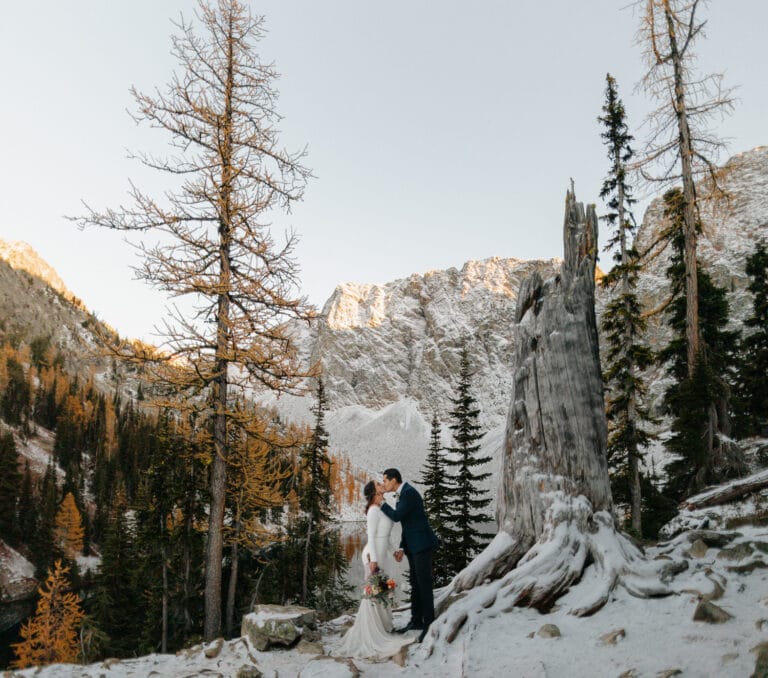
Then October brings larch season. These golden conifers draw visitors from all over for good reason. When the hillsides glow orange and an early snowfall dusts the peaks, it feels like stepping into a Bob Ross painting, just somehow the happy trees are yellow.
Down in the lowlands, fall color hits later. Maples around places like the Glacier area, the Washington Park Arboretum or many of our state parks turn vibrant toward late October and November.
By late fall, the rainy season becomes more consistent. If you are planning an October or November elopement, it is smart to have backup ideas whether that means indoor options, covered spaces or simply embracing good Gore Tex.
Winter
Winter in Washington splits into two very different personalities: rainy Washington and snowy Washington.
Rainy Washington covers most of the lowlands from Bellingham through Seattle, Tacoma and Olympia and all the way out to the coast. Winter days here are moody and quiet with soft light and deep greens. The San Juan Islands become calm and peaceful once the summer crowds leave. A city elopement in Seattle or Tacoma feels intimate. The Hoh Rainforest is almost mystical with how much water drips from every surface.
Snowy Washington begins once you reach the Cascades or cross into the eastern half of the state. This includes national park areas like Mount Rainier, ski towns like Leavenworth or Mazama and places like Spokane or Walla Walla. These communities are built for winter and know how to make the cold feel inviting. There are usually cozy places nearby to warm up between moments.
Winter does require a little planning. Not every mountain area is easy to reach when storms roll through. Passes can temporarily close and weather can switch from snow to rain depending on elevation. If you are considering an off-trail or backcountry location, it is essential to have avalanche experience and I’d suggest reports from a trusted source like the Northwest Avalance Center.
Spring
Spring in Washington feels like someone turned the saturation all the way up. When new leaves arrive, they come in a shade of green that feels unreal. It is a vibrant and hopeful season.
Spring also means waterfalls. Snowmelt turns every cascade into a roaring wall of water. Snoqualmie Falls is the classic choice and pairs beautifully with Salish Lodge. Franklin Falls, Palouse Falls, Spokane Falls, Nooksack Falls and even a quick hop to Wahkeena Falls in Oregon are all incredible this time of year.
This is not usually the season I recommend for high mountain elopements. Weather is unpredictable and snow lingers well into June or even July at higher elevations. Trails can be muddy, patchy or still buried in places.
Spring is a season for couples who are flexible and willing to roll with whatever the day brings. Rain, sun, wind and dramatic clouds can all happen within the same afternoon. If you can embrace that unpredictability, spring offers some of the most memorable moments.
How to choose your Washington Elopement location
Choosing where to elope in Washington is less about finding the single perfect spot and more about finding a landscape that feels like you. Mountains feel bold and expansive. Forests feel quiet and grounded. The coast feels wild and open. Lakes and hills feel calm and spacious. Each type of location creates a completely different experience for your day.
This is also the point where things can start to feel overwhelming. There are thousands of beautiful options and it is easy to spiral into saving too many spots. I always encourage couples to start by choosing the type of landscape they feel drawn to first. Once that part is clear, narrowing down exact locations becomes much easier.
If you want a deeper breakdown of specific spots, you can explore my full Where to Elope in Washington guide. Below is a simple starting point to help you get oriented.
Elope in the mountains
If you want your elopement to feel bold, expansive and alpine, the mountains of Washington deliver in a big way. This is where you find sharp ridgelines, wide open meadows, glaciers, wildflowers and light that changes fast and dramatically. Mountain elopements feel adventurous even when the hike is short.

Mount Rainier National Park
Mt Tahoma is the most iconic mountain in the state and one of the most popular elopement locations in Washington. On clear days it completely dominates the skyline. You can choose open meadows with full mountain views, quiet forest pullouts, waterfall backdrops or high ridges when conditions allow. Rainier works well for both intimate two person elopements and small groups, depending on location and permit needs. See full Mt Rainier National Park guide.
North Cascades National Park
The North Cascades feel sharper, darker and more rugged than Rainier. Peaks rise quickly from deep valleys and the scale feels dramatic. This is a great option for couples who want something that feels truly wild and remote without leaving the state. It is especially stunning in late summer and early fall. See Joe and Rachal’s Diablo Lake elopement.
Artist Point and Mount Baker
Artist Point at Mt Baker offers some of the most dramatic high alpine views in Washington with relatively easy access in the right season. This is a favorite for couples who want mountain drama without a long hike. Late summer and early fall are the most reliable windows for snow-free access.
Mountain weather changes fast. Even on sunny forecasts, wind, cloud cover and colder temperatures are always part of the experience. Mornings and evenings tend to be the quietest and most private times. Accessibility also varies widely from short walks to long hikes. Part of my role is helping you match your comfort level with the right kind of mountain experience.

Elope on the Washington coast
If you want your elopement to feel wild, open and a little untamed, the Washington coast delivers in a way that mountains and forests simply cannot. This is where land ends and the Pacific begins. The air smells like salt. The wind is always moving. The horizon feels endless. Coastal elopements feel raw and cinematic, even with the simplest plans.
San Juan Islands
The San Juan Islands offer a quieter, more intimate coastal experience. Think rocky shorelines, small harbors, evergreen hills and slow mornings by the water. You reach most islands by ferry, which immediately makes the day feel like an adventure. These islands are perfect for couples who want ocean energy without constant wind and waves. They are especially beautiful in late spring through early fall. See full San Juan Islands elopement guide.
Whidbey Island
Whidbey feels like a bridge between mainland Washington and island life. You get cliffs, beaches, driftwood, farmland and wide ocean views all in one place. It is one of the easiest island locations to reach and works well for both quick ceremonies and full weekend elopements.
Ruby Beach and La Push
This stretch of the Olympic Coast is known for sea stacks, misty weather and powerful surf. Beaches here feel dramatic in every season. Summer can bring gentler light and clearer views, while fall and winter offer mood, storms and crashing waves. These locations are ideal for couples who want that classic Pacific Northwest coastal feel.
Shi Shi Beach
Shi Shi feels remote and expansive. It requires a longer drive and a short hike to reach, but the reward is one of the most dramatic beaches in the state. Sea stacks rise straight out of the water and the beach stretches seemingly forever. This is a great option for couples who want an adventure built into their day.
Coastal weather changes fast and often comes with wind. Even in summer, it can feel cool near the water. Tides also matter for access at some beaches. The payoff is always worth it. The coast gives you energy, motion and a sense of scale that is impossible to fake.
Elope in the forest
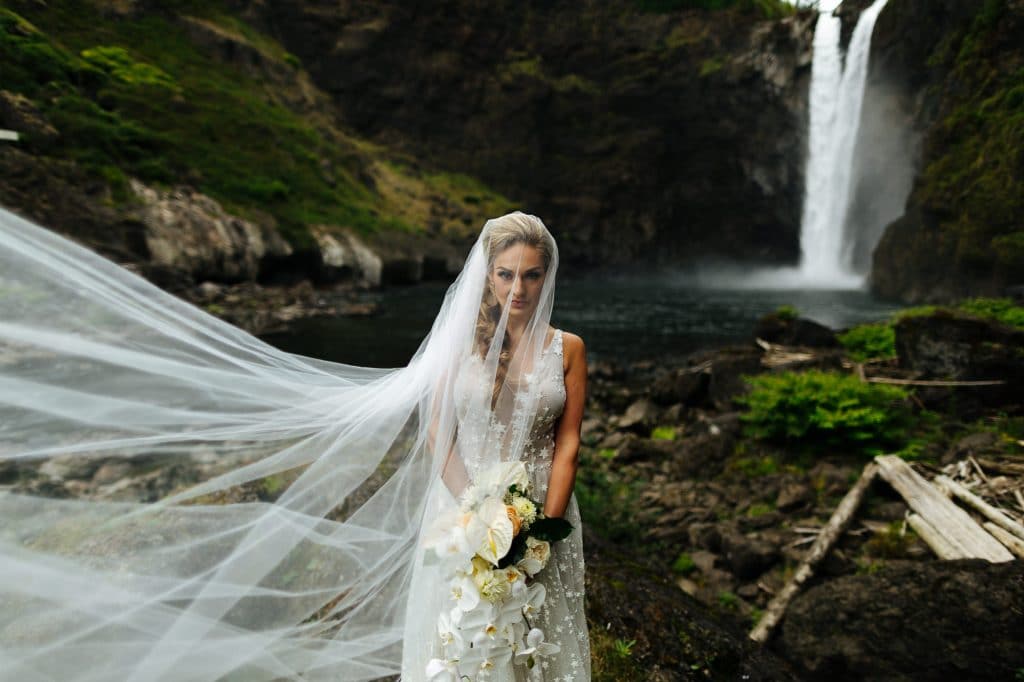
If mountains feel epic and the coast feels wild, forests feel intimate. Quiet. Grounded. Forest elopements in Washington are for couples who want to slow down, breathe deep and feel fully tucked into nature. This is where you elope when you want privacy, soft light and that deep green Pacific Northwest magic.
Olympic National Park Rainforests
The Hoh, Quinault, and Bogachiel rainforests feel untouched and ancient. Moss hangs thick from massive trees. Ferns blanket the ground. Light filters through in soft layers instead of harsh beams. These locations are ideal for couples who want moody, quiet and deeply atmospheric elopements. Rain is common here, but you knew this because it’s a rainforest.
Mt. Baker Snoqualmie National Forest
I almost hesitate to write this as an option because this forest stretches across a huge portion of western Washington and offers endless variety. It’s like saying “a really good type of food is mexican food.” There are endless options. You will find river valleys, old growth tree stands, mountain-adjacent forest roads and quiet trailheads. It works well for couples who want forest energy but also want the option to pivot toward views if weather allows.
North Cascades Lower Elevation Forests
While the North Cascades are known for rugged peaks, the lower forested areas are just as stunning. These locations offer dense evergreen canopies, rivers cutting through rock and far fewer crowds than many national parks. This is a great option for couples who want dramatic forest without heavy foot traffic. Though, it should be noted that Highway 20, the main road that crosses the park to Mazama closes in the winter. So just keep an eye on that.
Washington State Parks
Many state parks offer surprisingly dense forest environments with easy access. These work well for couples who want forest aesthetics without long hikes or complicated logistics. They are also some of the most permit-friendly locations. A few of my favorites are Deception Pass, Cape Disappointment, Lake Wenatchee, and Mount Pilchuck state parks.
Forest elopements are the most forgiving when it comes to weather. Overcast skies create soft, even light. Mist adds atmosphere. Wind is usually minimal. If you want to focus fully on each other without wide-open exposure, forests offer that sense of privacy and calm.

Elope near Seattle
Not everyone wants to drive three hours into the mountains or plan around remote trailheads. One of the best things about eloping in Washington is that you do not have to choose between convenience and beauty. Seattle sits in the middle of water, forests, mountains and islands. You can have an incredible elopement day and still enjoy all the Emerald City has to offer.
On a Washington State Ferry
Yes, you can absolutely elope on a Washington State ferry. This is one of the most underrated and uniquely Washington experiences you can have. You get open water, skyline views, mountain backdrops on clear days, and the steady movement of the boat beneath your feet. It feels cinematic and completely unforced. Ferry elopements work especially well for couples who want something playful, simple, and deeply local. You can also use the ferry as part of the story by eloping on board and then celebrating on an island (like Nichole & Ross).
Discovery Park
Right inside the city, Discovery Park offers bluffs, beaches, forested trails and wide views of Puget Sound. It feels wild for being so accessible. This is a great option for sunrise ceremonies, weekday elopements or couples who want Seattle energy without downtown crowds.
Rattlesnake Ledge and North Bend Area
About 40 minutes from Seattle, the Rattlesnake Ledge gives you quick access to cliffs, lakes, river valleys and forested trails. You can keep your day short and still get dramatic scenery. It is one of the easiest ways to mix accessibility with that classic mountain feel. This is a very popular hike. I would only suggest eloping here if you’re looking at a weekday celebration.
Snoqualmie Falls and Surrounding Forests
Snoqualmie Falls is iconic for a reason. The waterfall is massive and powerful year-round. While the main viewing platforms are crowded, there are quieter nearby forested areas that work beautifully for ceremonies. This area is ideal for couples who want water, trees and easy access all in one. It’s also perfect if you want to have a reception or just stay at Salish Lodge.
Whidbey Island and Bainbridge Island
Both islands are easy ferry rides from Seattle and offer a huge shift in pace. You get beaches, bluffs, small towns, farmland and quiet roads within an hour of downtown. These locations are perfect for couples who want their elopement to feel like a getaway without complicated logistics.
Near-Seattle elopements are ideal if you want to keep your day relaxed, minimize driving, invite a few guests, or avoid unpredictable mountain weather. You do not sacrifice beauty by staying close. You simply trade remoteness for ease and flexibility.

Elope in Eastern Washington
Eastern Washington feels like a different state entirely. The climate shifts, the light changes, and suddenly the Evergreen State turns into open sky, desert, vineyards, and dramatic basalt cliffs. If Western Washington is moody and lush, Eastern Washington is wide open, sunny, and grounded. It is quieter. Slower. And often far more predictable when it comes to weather.
One of the biggest draws of eloping east of the Cascades is the sunshine. While Seattle might be socked in with clouds, places like Wenatchee, Chelan, Walla Walla, and the Columbia River Gorge are often clear and warm. If consistent weather matters a lot to you, this side of the state deserves serious consideration.
Columbia River Gorge and Central Washington
The Gorge is full of sweeping river views, wind-carved cliffs, desert grasses, and endless horizon lines. It feels cinematic without requiring a huge hike. Places near Vantage, Quincy, and along the Columbia offer massive views that feel especially powerful at sunrise and sunset.
Wine Country and Rolling Hills
Walla Walla and the Yakima Valley bring a softer, more romantic version of Eastern Washington. Vineyards, golden hills, and warm summer evenings give this area a European feel in the right light. It is perfect for couples who want something scenic but relaxed, with good food and good wine as part of the experience.
High Desert and Coulees
Areas like Dry Falls, Sun Lakes, and the Channeled Scablands are some of the most geologically dramatic places in the state. Basalt cliffs, ancient flood paths, and quiet desert lakes create a completely different backdrop than anything west of the mountains. It feels remote in the best way.
Eastern Washington is an amazing option if you want:
- More predictable weather
- Fewer crowds
- Big skies and open space
- A totally different visual feel from the coast and forests
It is often overlooked in favor of mountains and beaches, but for the right couple, it ends up being the perfect fit.

Do you need a permit to elope in Washington
Once you choose your location, permits are often the next step. Many of Washington’s most beautiful places are protected as national parks, state parks, national forests, or city land, which means you usually need permission to hold a ceremony there. It is not the most romantic part of planning, but it is one of the most important. The good news is that permits are typically simple, affordable, and very manageable with a little planning. I help all my couples through this so nothing gets missed.
National Park wedding permits
The National Park Service genuinely wants people to enjoy the parks, and they are actually pretty easy to work with when it comes to wedding permits. If you plan to elope inside a National Park, you will need to obtain a Special Use Permit. This applies to parks like Mount Rainier National Park, Olympic National Park, and North Cascades National Park. Each park has its own rules about where ceremonies are allowed. Mount Rainier is the most strict, but they also have an extremely helpful map that clearly outlines approved locations.
You do not need a separate photography permit for your wedding in National Parks. Thanks to the EXPLORE Act, wedding photography is covered under your ceremony permit. Also worth noting: drones are illegal in all National Parks, no exceptions.
National Forest wedding permit
Permits for weddings in National Forests vary depending on the specific forest and ranger district. Many areas do not require a permit for small elopements, especially if you have fewer than 50 guests and are not using a heavily developed site. One well known exception is Artist Point, which does require a permit.
Where things can get confusing is photography. Some National Forests consider wedding photography to be non-commercial, which means no permit is needed. Others consider it commercial and do require one. This is where working with your photographer really matters. I always help couples confirm the correct rules for the specific area they are considering so there are no surprises.
Washington State Parks wedding permit
You do not need a general permit to elope in a Washington State Park. However, if you want to reserve a specific location like the Deception Pass Amphitheater, a picnic shelter, or a designated ceremony area, you will need to make a reservation through that individual park.
These reservations are usually very affordable, and I often recommend reserving something even for very small groups. It guarantees you a place to gather, set a cooler down, or take shelter if the weather shifts.
Photography permits in State Parks are a little inconsistent. Some parks require them and some do not. When we are reserving your ceremony location, we simply ask and make sure everything is handled correctly.
Wilderness Rules and Drones
Beyond permits, there are a few wilderness rules that are important to understand.
In National Parks, ceremonies must take place on established trails or designated areas. Wilderness ceremonies off trail are not allowed.
National Forests are less strict, and many allow more flexibility for true wilderness elopements.
Drones are illegal in all National Parks and designated Wilderness Areas (such as Alpine Lakes Wilderness).
Drones are usually allowed in normal National Forest land, but local restrictions can still apply.

How to get a Washington Marriage License
Washington makes it refreshingly easy to get married. As far as states that are not Nevada go, it is about as simple as it gets. Here are the main rules and logistics to know as you start planning:
No residency requirement
Neither partner needs to live in Washington to get married here. You can travel in from anywhere.
Your ceremony must take place in Washington
A Washington marriage license is only valid if the wedding is performed inside the state. Likewise, you cannot use a license from another state for a Washington elopement.
You need five people total for a legal wedding
That includes:
- The two of you
- One officiant (licensed clergy or judge)
- Two adult witnesses
Online ordinations are completely legal in Washington. And for what it is worth, I am also a legal officiant. If you are truly eloping with no guests, we have absolutely pulled in nearby hikers to witness. People are always excited to help.
You can apply in any county and marry anywhere in the state
You do not have to get married in the same county where you apply. If you live in Washington, it is usually easiest to apply in your home county. If you are flying in, King County is typically the most convenient option. You can start the application online, but you will still need to finalize it in person.
Cost and payment
Marriage licenses cost $169. You can usually pay with cash, check, credit card, or debit card.
There is a three day waiting period
You must wait three full days after receiving your license before getting married. If you are traveling to Washington for your elopement, be sure to arrive at least three days before your ceremony to take care of this.
Your license is valid for 60 days
Do not apply earlier than 63 days before your wedding day. Once that window opens, it is safe to apply. King County’s website is a good reference if you want to double check timing.
Sign with your current legal names
No matter what you plan to do with names after the wedding, you must sign the marriage license with your current legal information. You can request certified copies later for any name change paperwork.
Mail your license back after the ceremony
Your license will come with a return envelope, though it usually does not include a stamp. You are legally married as soon as the document is signed. If it gets lost in the mail, you are still married, but replacing the paperwork becomes more complicated.

Example elopement day timelines
Every elopement is different. Locations, seasons, weather, guest count, and personal priorities all change the flow of the day. But sometimes it really helps to see what a full elopement day can actually look like on paper.
The sample schedules below are based on a theoretical August 15 elopement and assume a one hour hike each way to the ceremony location. These are not meant to be rigid timelines. They are meant to give you realistic touchpoints for how long things take, how much time to allow for photos, and how a full wedding day can unfold without feeling rushed. Your actual day may look very different, and that is exactly how it should be.
Sunrise elopement
4:00 am – Meet at trailhead
4:30 am – Start hiking
5:30 am – Arrive at sunrise location
6:00 am – Start elopement ceremony
6:05 am – Sunrise
6:20 am – Done with ceremony
6:30 am – Portraits of couple in sunrise light
7:30 am – Group photos with other guests
8:00 am – Start hike out
9:00 am – Return to trailhead
10:00 am – Brunch
12:00 pm – Naps
Sunset elopement
4:30 pm – Meet at trailhead
5:00 pm – Begin hike to ceremony location
6:00 pm – Arrive at ceremony location
6:10 pm – Snacks
6:30 pm – Get dressed
7:00 pm – Ceremony
7:20 pm – Champagne Toast
7:30 pm – Group photos with guests
7:45 pm – Portraits of couple
8:21 pm – Sunset
8:45 pm – Done with portraits
9:00 pm – Begin hike
10:00 pm – Return to trailhead and go home

Add activities that personalize your elopement day
One of the best parts of eloping in Washington is that your wedding day does not have to follow a traditional script. There is no rush between venues. No rigid timeline built around vendors. You get to shape the day around the things that actually feel like you.
Activities give your elopement day structure without making it feel staged. They create natural moments for connection, movement, and quiet. They also help your day feel like an experience instead of just a short ceremony and a handful of photos. Below are a few activity ideas that fit especially well with Washington elopements.
A short hike
Perfect for couples who want epic scenery without a major physical effort. This is the most common option and works beautifully for sunrise and sunset ceremonies.
A long hike
For the couples who want the journey to be part of the story. These days feel big and earned, with wide open views and a real sense of adventure built in.
A forest walk
Slow, quiet, and intimate. Forest elopements are about soft light, mossy ground, and feeling completely tucked away from the world.
A beach fire (where allowed)
Nothing beats the calm chaos of a coastal fire. Wind, waves, driftwood, and a little warmth at the end of the day. Permits and local rules matter here, but when it works, it really works.
A canoe or kayak moment
Still water, early light, and a shared rhythm. Lakes, alpine tarns, and slow rivers all offer a very different pace than hiking.
A coffee or pastry stop
This is one of my favorite low key additions to a day. A small town bakery, a thermos at the trailhead, or espresso from the back of your car. It grounds the day in something normal and familiar.
A mountain picnic
Whether it is a full spread or just snacks on a rock, sharing food in a wild place always feels a little unreal in the best way.
A private vow reading
You can exchange vows during your ceremony, but many couples also choose to read private letters to each other earlier or later in the day. It creates space for something very personal without an audience.
A first dance under the trees
No crowd. No pressure. Just the two of you, a speaker, and a moment that feels completely yours.
You do not need to pack your day full of activities. One or two is often perfect. The goal is not to be busy. The goal is to let your elopement feel like a real day, not just an appointment.

What to Wear for Your Washington Elopement
Before we start, you already know your style. Lean into it. Be the coolest version of yourself. Wedding dresses do not have to be white. Bolo ties are fun. Do whatever you like. There is no style police here.
That said, there are a few practical things worth thinking about when you are planning a Washington adventure elopement. Most of the advice below is aimed at folks hiking, boating, or spending real time outside. If you are eloping somewhere close to civilization, you can safely ignore half of this and just look great.
I am breaking this into general guidance for dresses and for suits, but all of it is flexible and fully inclusive. Wear what feels most like you on your wedding day. I also have a full blog about this.
Tips for Elopement Dresses
Is it packable?
If you are hiking, you are going to be carrying your outfit up a mountain. That does not mean it has to be complicated. A dress bag lashed to the outside of a backpack works surprisingly well. It is also worth thinking about fabric choice. Tulle, lace, and embroidered fabrics hide wrinkles much better than silk or smooth satin. At least until JetBoil invents a dress steamer attachment.

Is it walkable?
Even at the top, you will be moving around more than you would at a traditional venue. A massive train can make that harder than it needs to be. Slits, lighter skirts, or dresses that you can bustle easily all make movement way easier.
Also, almost no one changes back out of their wedding dress after an elopement. You usually just hike back out in it. By that point, the idea of getting it dirty is way less scary. And honestly, that slightly dusty, lived in look photographs beautifully.
Is it layerable?
It can get cold in the mountains even in summer. When you are choosing a dress, consider whether leggings can fit underneath and whether a jacket can work over the top without feeling bulky.
Shoes are the same story. You can absolutely wear fancy shoes for photos, but you can also wear full on trail runners and no one will ever know if your feet are hidden. It is all about what you want to be visible.
Tips for Elopement Suits
Black shoes are easy to hide
You can bring cool dress shoes and we will absolutely make them look good in photos. Or you can wear black running shoes and your photographer will not draw attention to them. No one will ever know. Choose comfort or style or both. There is no wrong answer.

Think about wrinkles
Suits love to wrinkle. Wool and polyester both show creases easily when packed. Wrinkle resistant fabrics help a lot, and careful folding goes a long way. The suit jacket is the biggest thing to protect. Pants and shirts are generally easier to manage.
Breathability matters
If you are hiking in a suit, even a short distance, you are going to get warm. Lightweight, breathable fabrics make a huge difference, especially for summer elopements. Linen blends, lightweight wool, and modern technical suiting fabrics are all way more comfortable than heavy traditional materials.
Think about pockets
Suits do not have many usable pockets, and you probably do not want bulky things in your pants anyway. Sunglasses, vow books, rings, or phones usually need a plan. That might be a small backpack, your partner carrying a few items, or building time into the day to grab things when you arrive at the ceremony spot. This is a photographer speaking, please pretend your front pant pockets don’t exist. I will tell you to take stuff out of them.
General Items to Bring for an Adventure Elopement
No matter what you are wearing, these are things I strongly recommend bringing with you:
- Headlamp
- Snacks
- Water
- Warm layers
- Wind and rain layers
Washington weather likes to change its mind, and being prepared lets you relax and actually enjoy the day.

Let’s Talk Guest List
When it comes to elopements, the word itself means very different things to different people. Some folks define an elopement as just the two of you. Others stretch that definition well into what looks more like a small wedding. Personally, I am not the elopement police. You should call your celebration whatever feels right to you.
That said, for planning purposes, I usually see two practical categories:
- Small elopements: 7 or fewer guests
- Large elopements: 8 or more guests
Some vendors will tell you that anything over 20 people is no longer an elopement. I think that is mostly just semantics. The size of your guest list matters way more for logistics than for labels.
Small elopement guest list advice
Small elopements give you the most freedom. With just a few guests, your only real limitation is the physical ability and comfort level of the people you bring along.
It is easy to:
- Have a ceremony just off a short trail
- Elope on the Discovery Park bluff and then walk to a fancy dinner
- Hop on a ferry together
- Share a beach fire
- Or even go get matching tattoos afterward
Transportation is simple. Dinner is easy. Weather plans are flexible. And if you decide to pivot at the last minute because the light is perfect somewhere else, you usually can.
Small groups also tend to feel more emotionally intimate. There is less pressure to perform and more space to slow down and actually be in the day.
Large elopement guest list advice
Once you hit the 8 to 20+ guest range, things naturally need a little more structure. It does not mean your day is suddenly rigid or boring. It just means planning becomes more intentional.
A few things that change with a larger group:
- Transportation matters more. Long hikes and rough roads become less realistic.
- Dinner plans matter more. You are probably looking at a restaurant, catered meal, or reserved space instead of winging it.
- Ceremony locations become more limited. Some wild places simply cannot support larger groups without permits or impact concerns.
That does not mean you lose the magic. You can still stand in a circle under a cedar grove. You can still say your vows on a bluff overlooking the ocean. You just choose spaces that support people being comfortable, safe, and included.
Large elopements often feel like a really beautiful cross between a traditional wedding and an adventure day. You get the intimacy of small guest counts, with the energy of having your people around you.
Guest list reality check
No matter the size of your guest list, every added person increases:
- Coordination
- Timeline complexity
- Safety considerations
- And permit requirements in some locations
None of that is bad. It just changes how we approach the day. My goal is always to help you design something that feels aligned with your priorities while still being realistic for the number of people involved.

A Very General Elopement Budget (Spend on What You Care About)
One of the best parts of eloping is that you are not locked into a traditional wedding budget structure. You get to spend money on the things that actually matter to you and skip the things that do not. There is no required checklist. No required guest count. No required anything.
Some couples go all in on an incredible location and photos. Some prioritize a luxury place to stay. Some spend their money on food, wine, and experiences. Elopements give you the freedom to eschew what you do not care about and fully invest in what you do.
Here is a very simple, realistic breakdown using common Washington elopement numbers. This assumes you already live in Washington. If you are flying in, I trust that you’re smart enough to look up a flight to SeaTac.
Travel
Estimated: $50 to $300
For most Washington residents, travel is just gas and maybe a ferry ticket. A Sunrise hike on Mount Rainier and a coast day in Olympic National Park cost very different amounts in fuel, but neither is extreme compared to traditional wedding travel budgets.
Lodging
Estimated: $250 to $1,200 per night
You have a lot of range here, depending on priorities.
- A stay at somewhere iconic like Salish Lodge or Lake Quinault Lodge usually lands in the $400 to $800+ per night range, depending on season.
- A 10-person Airbnb split between a small group often ends up being $600 to $1,200 per night total, which can be shockingly affordable per person.
If you are hosting guests, lodging often becomes one of the biggest shared expenses and one of the most meaningful parts of the experience.
Permits
Estimated: $150
Most wedding permits in Washington land between $50 and $200. To keep things simple and safe for planning, $150 is a very realistic average to budget.
Photography
$5,000
That is my full day elopement coverage. Other photographers may be less or more, depending on experience, coverage time, and what is included. This is usually one of the largest line items, but it is also the one thing that lasts beyond the day itself. Send me a message and let’s talk about your dreams.
Florals
Estimated: $200 to $1,000+
Florals vary wildly based on:
- Bouquet size
- Fresh vs dried
- Local vs destination florist
- Installations vs handheld
A simple bridal bouquet often lands around $200 to $350.
A bouquet plus boutonniere might be $350 to $600.
Large installations, arches, or multiple arrangements can easily pass $1,000+.
Many elopement couples also skip florals entirely or make their own for less than $50 with flowers for Pike Place Market
Food and Drink
Estimated: $200 to $1,500+
This depends on guest count and how you celebrate.
A few examples:
- Post-hike pizza and beer for 6 people: $150 to $250
- Nice restaurant dinner for 8: $600 to $1,200
- Private chef or catered dinner for 10 at an Airbnb: $1,000 to $1,500+
You can eat snacks on a mountain or host a full-blown dinner party. Both are valid wedding meals.
Optional Activities
Estimated: $100 to $1,000+
These are the extras that make elopements feel personal:
- Kayak rentals
- Ferry rides
- Charcuterie boards
- Champagne
- Tattoos
- Boat charters
- Guided hikes
Some couples spend almost nothing here. Others build their entire day around an experience.
The Big Takeaway
There is no correct elopement budget. There is only an intentional one.
Some couples spend $6,000 all in.
Some spend $15,000.
Some spend far more because they choose to.
The beauty of eloping in Washington is that you get to design a day where:
- Your money supports your values
- Your time supports your experience
- And nothing is included just because tradition says it should be

Choose your elopement photographer
Your photographer is one of the most important decisions you will make for your Washington elopement, not just because of the photos, but because of the role they play in the entire experience. A great Washington elopement photographer helps you choose locations that actually work, builds a realistic timeline, understands permits and weather patterns, and knows how to adapt when conditions shift. Beyond logistics, they set the tone for the day, help you feel comfortable in front of the camera, and protect space for real moments to unfold. The right photographer is part documentarian, part guide, and part steady presence.


